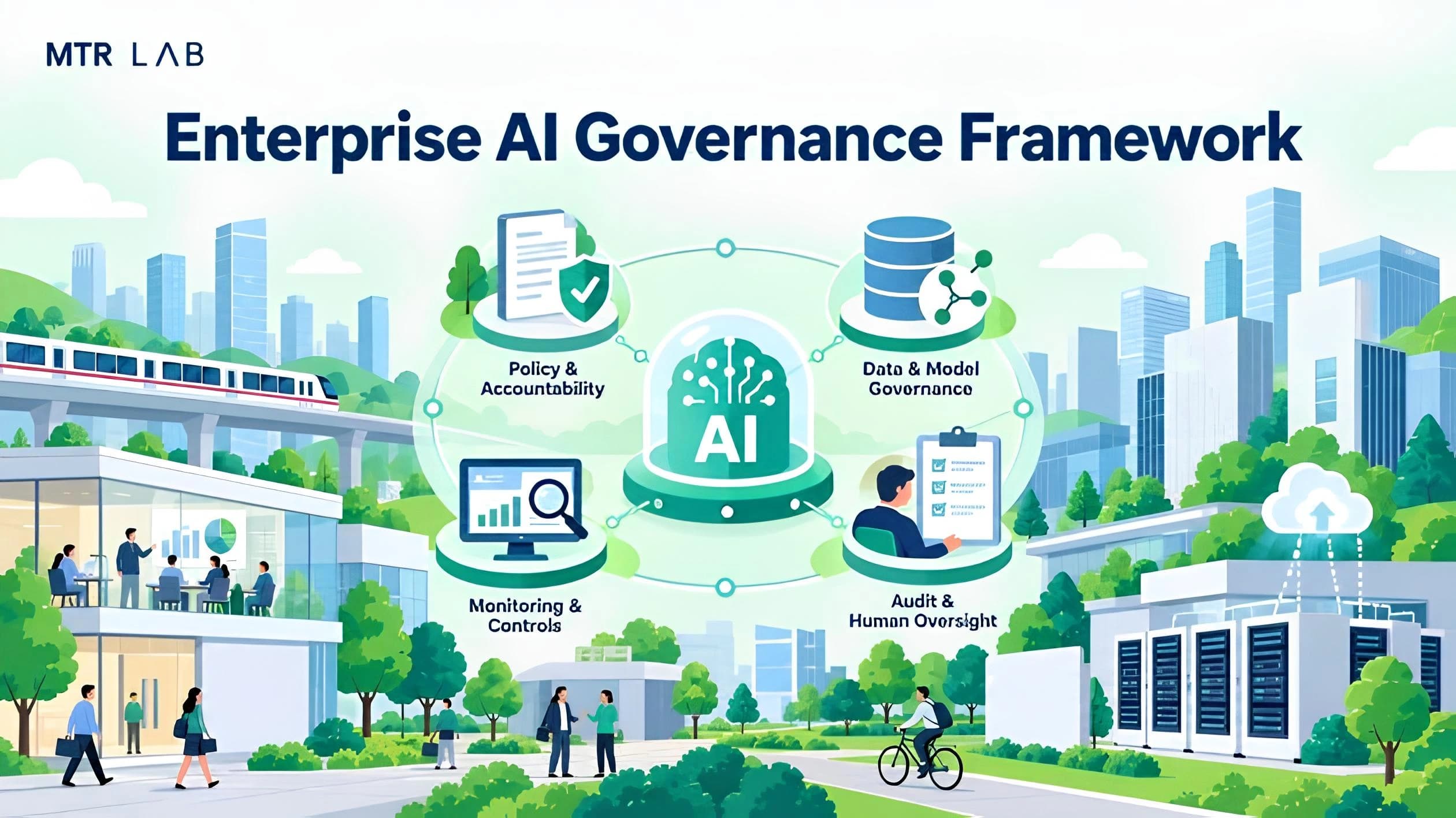
AI is becoming easier to deploy, but enterprise adoption is becoming harder to govern. For high-growth technology companies, an AI product may perform well in a pilot yet still struggle to pass the security and risk reviews required by a large corporate buyer.
An effective business corporate AI governance framework helps enterprises close that gap. It translates responsible AI principles into policies, technical controls, and evidence that can be reviewed by regulators and internal decision-makers.
Why Does AI Governance Matter for Enterprise?
While enterprise procurement teams coordinate third-party due diligence, internal governance is driven cross-functionally across IT, risk management, legal, central AI governance functions, and business units. Large organisations rarely assess an AI solution on technical performance alone. Enterprise buyers and cross-functional evaluation committees increasingly need to understand what data a system uses, how outputs are produced, who remains accountable, and what happens when something goes wrong. Without an enterprise-grade AI governance framework, unaddressed legal liabilities, data leakage, model bias, and brand reputation risks act as severe barriers to adoption, causing B2B sales cycles to stall indefinitely. Large organisations rarely assess an AI governance solution on technical performance alone. Procurement teams increasingly need to understand what data a system uses, how outputs are produced, who remains accountable and what happens when something goes wrong. Without an enterprise-grade AI governance framework, unaddressed legal liabilities, data leakage, model bias, and brand reputation risks act as severe barriers to adoption, causing B2B sales cycles to stall indefinitely.
Weak AI governance can create several forms of risk:
- Data and privacy risk: confidential, personal or commercially sensitive information may enter models or external AI services without adequate controls.
- Model risk: biased, inaccurate or unstable outputs can affect business decisions and customer outcomes.
- Security risk: AI applications may introduce new attack surfaces, including prompt injection, sensitive information disclosure and unsafe third-party integrations.
- Accountability risk: unclear ownership between product, IT, legal, security and business teams can leave important decisions unresolved.
- Reputational risk: failures that appear manageable from a technical perspective can become significant once they affect customers, employees, or the public
By framing a robust AI governance framework for business as a strategic revenue accelerator rather than a defensive compliance exercise, scale-ups can capture significant commercial advantages. Effective AI governance is closely linked to strong data governance, privacy controls and organisational trust. According to Cisco's 2025 Privacy Benchmark Study, over 75% of organisations report that privacy investments help reduce sales delays, mitigate security losses, enhance customer trust and loyalty, and boost overall company attractiveness.
The governance gap remains significant. IBM's 2023 Global AI Adoption Index found that, although 83% of organisations exploring or deploying AI considered explainability important to their business, fewer than half reported implementing key trustworthy AI practices. This gap creates an opportunity for AI vendors to demonstrate stronger governance maturity during enterprise procurement and onboarding for enterprise users.
A good AI governance framework can reduce avoidable uncertainty by making responsibility, technical controls and risk-management processes easier for buyers to evaluate.
Key Principles and Structural Components of Enterprise-Grade AI Governance
What is an AI governance framework? An AI governance framework for enterprises is the system through which an organisation directs, controls and monitors the development, enterprise procurement, adoption by enterprise users, and use of AI. It connects areas that are often managed separately, including organisational accountability, data and model governance, operational controls and ongoing monitoring.
To build an effective corporate AI governance framework, organisations must understand the distinction between AI Ethics and AI Governance. While AI Ethics defines aspirational values, moral principles, and philosophical guidelines, AI Governance is the strict operationalization of those values into enforceable policies, technical controls, and auditable evidence.
A robust corporate AI governance framework should normally address five core principles:
- Transparency: stakeholders should understand where AI is being used and, where appropriate, how important outputs are generated.
- Explainability: organisations should be able to provide meaningful information about the factors behind material AI-assisted decisions.
- Fairness: AI systems should be assessed for harmful or unjustified bias.
- Robustness: systems should operate reliably within defined conditions and respond safely when those conditions change.
- Accountability: named individuals or functions should remain responsible for AI decisions, with human review or override where the level of risk warrants it.
These principles of the AI governance framework can be integrated into four structural areas:
- Policy and accountability: define permitted uses, prohibited uses, decision rights, escalation procedures and ownership.
- Data and model governance: document data sources, model versions, validation, access rights, limitations and third-party dependencies.
- Operational controls and monitoring: monitor performance, security events, model drift and changes in how the AI system is used.
- Auditability and lineage: maintain records that allow teams to trace important datasets, models, prompts, decisions and system changes.
Bridging Operational Performance and Internal AI Governance:
When deploying AI into operational environments, there are two interconnected layers of AI in operations: governing the AI itself and using AI to govern operational performance.
- Using AI for Operational Monitoring (The External Layer): Directed outward at physical assets. The AI system continuously monitors equipment health, automates anomaly detection, and drives predictive maintenance that reduces downtime and boosts operational productivity.
- Governing the AI System Itself (The Internal Control Layer): Directed inward at the models and data. For external monitoring to function reliably, the AI itself requires active governance anchored in a sound framework. This covers core operational controls including sensor data integrity, alert validation workflows, engineer intervention protocols, and defined procedures for handling low model confidence.
Ultimately, these two layers form a vital symbiotic loop: rigorously governing internal algorithmic controls serves as the essential trust foundation that makes safely using AI to govern physical operations possible.
Case Study: How Ensonic uses AI for Operational Monitoring
A well-defined AI governance framework becomes particularly important when AI interacts with physical infrastructure.
Ensonic, an MTR Lab portfolio company, develops acoustic AI technology for predictive maintenance. Its solutions rely on stringent real-time acoustic data monitoring, edge signal processing and algorithmic analysis to detect early-stage equipment faults, generate prioritised alerts and give engineers clear, actionable visibility into asset condition.
MTR Lab's strategic investment supports Ensonic in enhancing solutions aligned with international standards and boosting its overseas expansion, establishing a robust AI governance and technical foundation for enterprise deployment in sectors like power grids and railway operators. By integrating internal model controls and operational validation, Ensonic ensures its automated alerts meet the rigorous performance thresholds required for secure deployment.

International Benchmarks: NIST AI RMF, ISO/IEC 42001:2023 and the EU AI Act
While no single, universally mandated AI governance framework for business exists globally, the international ecosystem relies on several widely recognized benchmarks and standard
| Benchmark | Key Focus |
| NIST AI RMF 1.0 | A voluntary risk-management framework organised around four functions: • Govern: Establishes governance roles, policies and accountability • Map: Identifies AI use cases and maps associated risks • Measure: Quantifies risk levels, model performance and control effectiveness • Manage: Implements risk mitigation and continuous optimisation |
| ISO/IEC 42001:2023 | An AI management system standard based on the Plan-Do-Check-Act (PDCA) cycle. |
| EU AI Act | A legally binding, risk-based framework. It distinguishes unacceptable risk, high risk, transparency risk, and minimal or no risk, with different obligations depending on the system and use case. |
For high-growth scale-ups, adopting a hybrid approach to AI governance, such as integrating risk management frameworks, management system standards, and regional legal baselines, represents a practical path to enterprise compliance. Companies can use NIST AI RMF as the operational structure for identifying and managing AI risks, while ISO/IEC 42001:2023 provides a broader management-system foundation for governance, accountability and continuous improvement.
Regional regulation should then form the legal baseline. For example, scale-ups operating in the EU need to assess obligations under the EU AI Act, while companies handling personal or cross-boundary data in other markets must also account for relevant local privacy and data-transfer requirements.
Establishing AI Governance in Corporations: Overcoming Common Implementation Challenges
Making an AI governance framework for enterprises work across an organisation is no easy feat. Several common challenges in corporate AI governance implementation tend to appear.
- Unclear ownership and accountability: legal, information security, IT, compliance and product teams may all have responsibilities without a clear decision-maker.
- Shadow AI and data blind spots: employees may use external AI tools outside approved workflows, making it difficult to understand where corporate data is being processed.
- Fragmented systems: departments may use separate models, vendors and monitoring tools, making consistent oversight difficult.
- One-time approvals: models and use cases continue to change after launch, so governance cannot end with a single pre-deployment review.
- Third-party dependencies: organisations may rely on foundation models or AI-as-a-service providers without complete visibility into underlying systems.
- Skills gaps: effective governance requires knowledge spanning machine learning, cyber security, privacy, regulation and business operations.
These bottlenecks create a clear opportunity for scale-ups to remove friction for enterprise buyers through governance-by-design:
- Solve ownership silos: Provide turn-key RACI templates and executive compliance summaries tailored for CISOs, legal teams and business leads, to clarify decision rights out of the box.
- Combat shadow AI and vendor risk: Deliver comprehensive vendor security packs, transparent model cards and clear data privacy architecture to eliminate buyer liability concerns.
- Enable continuous oversight: Build native API hooks that integrate directly into enterprise monitoring systems, replacing static pre-deployment approval hurdles
Best Practices for Corporate AI Governance at Scale
The strongest corporate AI governance framework is one that operates with the product. By embedding governance requirements directly into end-to-end development and operational workflows, organisations can achieve continuous, consistent and repeatable AI compliance at enterprise scale.
Key globally recognised practices include:
- Automated Model Lineage Logging
- Dynamic Risk Scoring
- Continuous Red Teaming
- Open Explainability APIs
This design-first approach extends natively into technical delivery pipelines. Governance checks can be built directly into CI/CD workflows, so that compliance tests and required audit evidence are generated automatically as software changes progress toward production.
At enterprise scale, robust security infrastructure is a foundational enabler of governance by design. As AI agents, APIs and internal applications evolve, security controls become inseparable from governance controls.
Case Study: Enterprise Cybersecurity as a Governance Enabler—— Eagle Cloud
Building on its recent momentum following its nearly RMB 100M Series B+ funding round, Eagle Cloud ,an MTR Lab portfolio company, develops enterprise cybersecurity and AI-governance infrastructure. It has demonstrated solid growth potential in the AI governance space through its ongoing technological innovation, mature enterprise-grade products, and ability to address real customer pain points. Focusing on enterprise cybersecurity infrastructure, it embeds AI governance guardrails natively into daily workflows.

By utilising lightweight single-agent architectures, zero-trust network access (ZTNA), Eagle Cloud assists organisations in applying zero-trust policies uniformly across human employees and autonomous AI agents . These technical capabilities help enterprises define data access boundaries, reducing the risk of sensitive source code and customer data exposure via external LLMs. By consolidating network access, endpoint control, data loss prevention (DLP) and insider risk management (IRM) into a single console, it delivers enterprise-scalable security features that help organizations put governance-by-design principles into practice.
Sharing the same vision as MTR Lab, Eagle Cloud is dedicated to adding unique value to enterprise customers looking to deploy AI effectively and safely as they embrace the AI era. Through strategic investment, MTR Lab hopes to support Eagle Cloud in further enhancing its technology solutions and expanding its overseas service capabilities to support broader market adoption.
As enterprises accelerate AI adoption, governance increasingly depends on secure infrastructure foundations. MTR Lab's investment thesis in AI infrastructure and cybersecurity reflects the growing importance of enabling technologies that support responsible deployment at scale.
Generative AI and LLM Security: Technical Guardrails and Data Privacy Controls
Generative AI introduces specialized threat vectors into an AI governance framework for business, including prompt injection, hallucination risks, sensitive information disclosure, supply-chain vulnerabilities, and model poisoning.
These risks make technical controls an important part of enterprise AI governance:
- LLM guardrails: constrain inputs, outputs and permitted actions.
- Role-based access control: ensure users and AI agents access only the information required for their functions.
- PII and sensitive-data controls: detect, mask or prevent inappropriate data exposure.
- Output validation: review relevant model responses before they trigger transactions or operational actions.
- Logging and lineage: preserve records showing how significant outputs or actions were produced.
- Continuous telemetry: monitor unusual model, user or agent behaviour.
This becomes especially relevant for businesses operating across Hong Kong and the Greater Bay Area, where cross-border data transfers may introduce additional privacy and compliance considerations. For scale-ups, these controls should form part of a wider AI governance framework that supports enterprise procurement and risk assessment.
Suggested Reading: LLM Security Best Practices: Mitigating Enterprise Risks and Attacks
Steps to Achieve Enterprise AI Governance Readiness
Phase 1: Map AI assets and risk.
Create an inventory of models, datasets, APIs, external AI services and material use cases. Classify them according to business and technical risk.
Phase 2: Define policies and ownership.
Establish acceptable-use rules, escalation paths and decision rights. Map current practices against relevant governance standards and legal requirements.
Phase 3: Implement priority controls.
Introduce access management, sensitive-data protection, model documentation, logging and relevant LLM guardrails.
Phase 4: Test and monitor.
Conduct relevant security and adversarial testing. Establish performance, drift and incident thresholds.
Phase 5: Prepare enterprise evidence.
Turn governance activities into documentation that buyers can assess, including architecture information, security evidence, risk assessments and procurement responses.
Scale-Up Procurement Compliance Checklist
- Data privacy and audit trail: where does data originate, who can access it, where is it processed and what activity is logged?
- Security and vulnerability management: how are material vulnerabilities identified, prioritised and remediated?
- Bias and model assessment: which risks have been tested, and how are limitations communicated?
- Fallback and human oversight: what happens when the model fails, becomes unavailable or generates an uncertain result?
- Third-party risk: which external models, APIs and infrastructure providers are involved, and how are their risks reviewed?
From Governance Requirement to Scale-Up Capability
For high-growth AI companies, governance is becoming part of the infrastructure required to scale. A strong business corporate AI governance framework for enterprises gives customers greater visibility and control over their AI capabilities. This matters particularly for growth-stage ventures seeking to move from pilots into wider enterprise adoption. Strong governance helps bridge the gap between innovative technology and the risk controls that corporate buyers expect, reducing unnecessary friction during due diligence and procurement.
Focusing on smart city and sustainability-related sectors, MTR Lab is committed to driving the scalable growth of deep tech companies while emphasising AI infrastructure and security governance capabilities. If you are an AI and DeepTech scale-ups developing solutions for smart cities and next-generation urban systems, MTR Lab can support you with strategic funding, technology validation, and deployment opportunities. Submit your pitch to start the conversation.
Frequently Asked Questions
1. What is the primary operational difference between AI governance and AI risk management?
AI governance defines overarching principles, policies, and accountability for AI across an organisation. AI risk management operates within that structure as a tactical process, focusing specifically on identifying, measuring, and mitigating individual AI risks using frameworks like NIST's Map, Measure, and Manage functions.
2. Which KPIs can demonstrate AI governance strength to enterprise buyers?
Scale-ups should track key metrics: Model Bias Differential, Time-to-Detect/Remediate (TTD/TTR) for model drift, 100% Audit Log Coverage across inference pipelines, Vulnerability Patching SLA Adherence, and Security Vetting Pass Rates.
