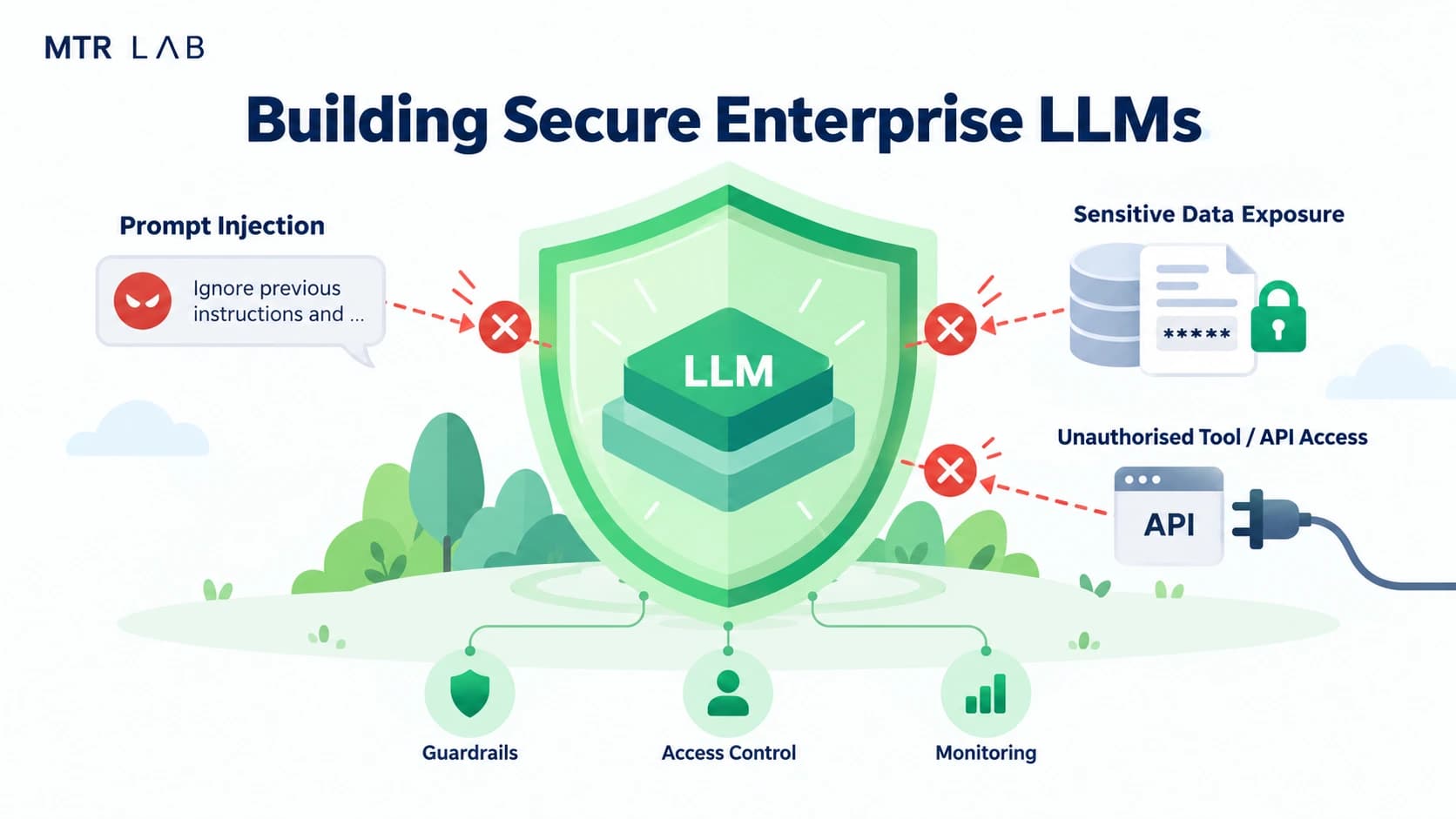
Large language models (LLMs) are moving beyond standalone chatbots. They are being connected to enterprise data, software tools and increasingly autonomous AI agents. To safely scale deployment, technology teams must address critical LLM security risks and defend against security attacks. Implementing strong LLM security best practices and standards is essential for enterprises.
Understanding LLM Security and the Enterprise AI Governance Imperative
What is LLM security? LLM security refers to the technical and organisational measures used to protect large language model applications from misuse, manipulation, data exposure and unintended behaviour.
Three layers shape LLM security.
At the model layer, security considerations include model integrity, training and fine-tuning data, model supply chains and adversarial manipulation.
At the data layer, organisations need to protect sensitive information used in prompts, retrieval systems, embeddings and model outputs.
At the application layer, controls must govern how an LLM interacts with users, APIs, databases and other enterprise systems.
This creates challenges that differ from conventional software. A traditional application follows predefined logic, while an LLM interprets language and produces probabilistic responses. Even a simple natural-language instruction from a user can change how a model behaves.
The challenge expands as generative AI connects across the technology stack: Retrieval-Augmented Generation (RAG) enables the system to retrieve internal information, external tools allow it to interact with software, and AI agents with appropriate permissions may trigger automated actions. Without proper boundaries, these integrated capabilities create expanded attack vectors across enterprise systems.
For these reasons, enterprises need to establish governance over LLM security risks.
Key OWASP LLM Security Risks and Vulnerabilities
The OWASP GenAI LLM Top 10 (2026) provides a standardized framework for analyzing vulnerabilities, including prompt injection, sensitive information disclosure, excessive agency, supply chain risks, data and model poisoning, unbounded consumption, misinformation, hidden context exposure, vector and embedding weaknesses, and improper output handling.
For enterprises, these categories demonstrate why LLM security attacks cannot be treated as a single vulnerability. Different controls are required across the full application and data lifecycle.
The following areas break down several of the most impactful LLM security risks for enterprise AI deployments.
Prompt Injection and System Prompt Leakage
Prompt injection, one of the most prevalent LLM security attacks, occurs when an instruction causes an LLM to behave differently from the way its application was intended to operate. Two forms are particularly relevant:
- Direct prompt injection: a user deliberately provides instructions designed to override normal application behaviour or model safeguards.
- Indirect prompt injection: malicious instructions are embedded in external content, such as a website, document or file retrieved by a RAG system.
Indirect attacks are particularly important for enterprise applications because an LLM may retrieve information from sources that the application does not fully control. Malicious text in those sources may be interpreted as an instruction.
System prompt leakage is related but distinct. It occurs when hidden, non-user-facing system instructions or operational context placed in a model's context are extracted, inferred, or reconstructed. While it does not necessarily expose the complete backend architecture or decision-making process, exposing this hidden context can reveal specific internal instructions, control mechanisms, and design details. For example, discovering proprietary business logic, API endpoints, or security guardrails allows attackers to refine subsequent LLM security attacks.
Sensitive Information Disclosure and Data Poisoning
LLMs can process large amounts of internal and user-supplied information. Without suitable controls, confidential data may appear in outputs or pass into systems where it should not be stored.
● Personally identifiable information may be exposed through model outputs.
● Confidential corporate information may enter public or unapproved AI systems.
● Sensitive documents may be retrieved for users who should not have access to them.
● Prompts and generated outputs may create new data-governance or retention risks.
Core LLM security best practices for this risk include data minimisation, access management, masking, anonymisation, output filtering and clear rules governing what information may enter an AI system.
Another risk appears when attackers manipulate the data used to train or fine-tune a model. These data poisoning attacks can introduce misleading information, bias or hidden vulnerabilities into training and retrieval datasets. Similar risks can affect vector databases used by RAG applications.
Excessive Agency and Unbounded Consumption
AI agents create a distinct class of LLM security risks, as they can act rather than simply respond.
Excessive Agency occurs when an LLM-based system receives more permissions than it needs. An assistant designed to retrieve information, for example, should not automatically receive permission to modify or delete records.
The LLM security risk becomes more significant as AI agents connect with databases, APIs and other enterprise applications. Human approval is still appropriate for actions that affect sensitive information, critical infrastructure or high-impact business decisions.
Unbounded Consumption concerns excessive use of model resources. Malicious requests or poorly controlled workloads may consume large amounts of compute capacity, context windows or API usage. This can affect system availability and increase operating costs.
Shadow AI and Employee-Led AI Adoption Risks
Shadow AI refers to AI tools, applications or agents that are used or deployed within an organisation without sufficient approval.
The immediate concern is often data. Employees may upload proprietary documents, customer information, source code or other confidential material to tools that have not been approved for business use. Organisations may then have little visibility into what was entered, which files were uploaded, and what outputs were generated.
A compounding issue is lack of visibility. Security teams may have no reliable monitoring or audit trail. Data-retention requirements may be difficult to enforce. Employees may unknowingly process information in ways that conflict with internal policies, customer commitments or regulatory requirements.
Accordingly, practical LLM security practices combine governance with usable alternatives. Organisations can establish clear AI-use policies, define which data classifications may be processed by AI systems, provide approved enterprise AI tools, apply appropriate access and monitoring controls, and educate employees about the risks of entering sensitive information into unapproved services.
Private AI Deployment: Self-Hosted vs Managed LLMs
Private AI deployment relies on two distinct yet interlinked decisions that underpin all LLM security standards implementation: the model’s licensing (open-weight vs proprietary) and its hosting model (self-hosted vs managed).
Open-weight models are typically self-hosted for greater control, while proprietary LLMs are most often used via managed APIs. Both model types can run in either deployment mode.
When choosing between hosting models, considerations should include data sensitivity, technical capabilities, compliance requirements, and operational risks, as shown in the table below.
Security Consideration | Self-Hosted LLM | Managed LLMs |
Data sovereignty | Offers greater direct control when infrastructure and data storage are managed internally. | Depends on the provider's architecture, hosting arrangements, contractual terms and data-processing policies. |
Auditability | Can provide greater visibility into the model and deployment stack, although transparency varies between models. | Often depends more heavily on vendor documentation, contractual controls and available audit information. |
Vulnerability patching | Internal teams need to monitor upstream vulnerabilities and manage updates. | The provider may handle patches centrally, reducing operational work but giving customers less direct control. |
Compliance boundary | More infrastructure and governance responsibility remains within the organisation. | Responsibility is shared between the organisation and the service provider. |
Custom security controls | Offers greater flexibility around isolation, permissions and monitoring. | Controls depend on the deployment and security options made available by the provider. |
Operational overhead | Requires stronger infrastructure, MLOps and security capabilities within the organisation. | Can reduce infrastructure management requirements, although vendor-risk management remains important. |
Self-hosted LLMs are often better suited to organisations that require tight control over sensitive data, infrastructure, access and auditability. Managed LLM services can be more suitable when faster deployment, lower operational overhead and provider-managed maintenance are stronger priorities.
Case Study: Enterprise AI in Practice: Whale
MTR Lab portfolio company Whale illustrates how data infrastructure and security capabilities can support enterprise AI adoption.
Whale develops AI-native enterprise solutions designed to help businesses automate workflows, improve decision-making and address operational challenges. Its Alivia platform supports local deployment, allowing enterprise data to remain on an organisation’s own servers. The platform also offers encryption across the content pipeline and granular user and team permissions. Its AI Asset Hub provides centralised management of models, agents and skills, with lifecycle governance and real-time task monitoring.
Alongside these capabilities, Whale has reported substantial deployment and usage across its product portfolio. In May 2025, the company reported that SpaceSight had been deployed across more than 300,000 stores, while Alivia was processing over seven million AI requests daily. At that time, Whale also reported more than 60 fine-tuned private AI models developed for enterprise use. By July 2026, the company reported serving more than 1,600 enterprise customers across at least 45 countries. Its solutions support organisations in sectors including healthcare, retail and automotive, helping businesses address challenges in compliance auditing, service quality and operational efficiency.
For MTR Lab, the investment relevance is not simply that security matters in principle, but that it can indicate whether an AI company is genuinely ready for enterprise adoption and scale. Whale illustrates this connection: its local deployment, encryption, granular permissions and lifecycle governance support customers operating across data-sensitive sectors and multiple markets. Security capability therefore matters within an investment assessment not as a standalone compliance feature, but as evidence that the technology can meet enterprise requirements as the business grows. Beyond capital, MTR Lab seeks to connect portfolio companies with market insights and potential PoC opportunities that may support cross-border growth.
Tactical LLM Security Best Practices for Developers and Tech Leads
Effective LLM security best practices should be integrated into the development lifecycle. Here’s what developers can do:
1. Implement bidirectional guardrails.
Validate inputs before they reach the model and inspect outputs before they reach users or downstream systems. Controls include prompt screening, sensitive-data masking and context-specific output validation. Generated content should also be treated as untrusted input when it is passed to another application or system.
2. Apply the principle of least privilege.
Give an LLM or AI agent access only to the systems, data and functions required for its task. Read-only access should remain read-only. High-impact actions may require additional approval or human confirmation.
3. Validate and sanitise RAG data sources.
RAG systems inherit risk from the documents and databases they retrieve. Organisations should verify the provenance of trusted sources, restrict who can modify them and monitor newly indexed content.
4. Establish continuous red-teaming.
Continuous red-teaming can help uncover LLM security attacks before production. Teams can test prompt injection, indirect injection, data leakage, poisoned retrieval sources, unexpected tool use and attempts to bypass application controls.Testing should continue when models, system prompts, datasets or connected tools change.
5. Deploy real-time monitoring and rate limiting.
Production systems need logging, alerting, rate limits and usage thresholds. Monitoring unusual token consumption, repeated failed requests and unexpected system actions can help teams identify both attacks and operational problems.
Aligning LLM Security with Global Compliance and Enterprise Standards
Technical defences become more useful when they sit within recognised LLM security standards and governance structures. For organisations deploying AI at scale, security needs to connect with defined responsibilities, risk assessment, monitoring and management processes.
ISO/IEC 42001:2023 provides a management-system standard for governing AI across an organisation. It focuses on establishing AI policies, assigning responsibilities, assessing and treating AI risks, monitoring performance and continuously improving governance through a Plan-Do-Check-Act cycle.
The NIST AI Risk Management Framework takes a more risk-focused approach. Its core is organised around four functions:
●Govern: establishes accountability and risk-management processes;
●Map: identifies the context and potential risks of an AI system;
●Measure: assesses and monitors those risks;
●Manage: prioritises, responds to and manages identified AI risks.
These frameworks provide a structured basis for governing LLM security risks. They help organisations establish a structured approach to LLM security, embedding clear ownership, formal governance processes, risk assessment, and continuous oversight across the full AI lifecycle.
For enterprises, LLM security also intersects with legal and compliance requirements. Key issues can include personal data protection, data retention, cross-border data transfers, access to confidential information, third-party model providers and accountability for AI-assisted decisions. The applicable obligations depend on the jurisdiction, industry and type of data being processed.
Evaluating Vendor Security and Model Capabilities in Enterprise Procurement
When evaluating prospective AI solutions, choosing a trustworthy LLM provider offers a practical demonstration of applying LLM security principles in enterprise LLM deployments.
For enterprises procuring AI solutions, the vendor clarifies key security dimensions: locations of customer data processing, access control mechanisms, evaluation procedures for models and third-party components, incident response protocols, and audit capabilities for critical system activities. Its platform segregates enterprise and personal workspaces, and does not use enterprise data for model training by default. Instead of relying on disjointed, ad-hoc security reviews, the vendor adopts a verifiable control framework aligned with widely accepted governance benchmarks, which streamlines vendor due diligence and contract review workflows.
At the foundation model layer, companies such as Moonshot AI illustrate this evolution through its Kimi K3 model that combines open weights with a one-million-token context window to support demanding enterprise knowledge work and agentic workflows. From a security and compliance perspective, Moonshot AI's Kimi Business plan separates personal and enterprise workspaces and does not use business data for model training by default, while its platform privacy policy describes real-time monitoring for abnormal data access and a security-incident notification process.
Down a t the compute layer, Cerebras illustrates how new hardware architectures can support increasingly demanding AI workloads. Its Wafer-Scale Engine is designed to improve computational efficiency and simplify the deployment of foundation models. Furthermore, Cerebras anchors its enterprise readiness with a comprehensive Trust Center framework (including SOC 2 Type 2, GDPR, and CCPA alignment), enforcing rigorous encryption standards, strict data access controls, and administrative safeguards to prevent the unauthorised persistence of customer inputs and inference data.
By aligning these provider capabilities and workflows with established LLM security frameworks, the vendors can produce more robust evidence for buyers during procurement and risk assessment.
Compliance should therefore be treated as an integral component of enterprise AI readiness. Where technical safeguards, governance rules and audit evidence are built into one unified design, prospective customers and partners gain greater confidence when evaluating AI offerings.
Scaling Secure, Enterprise-Ready AI with MTR Lab
The next phase of enterprise AI is likely to be shaped not only by increasingly capable models, but also by the infrastructure and governance that allow those models to operate safely at scale.
For companies developing AI, mitigating LLM security risks and defending against attacks are core commercial requirements for B2B adoption. Adopting LLM security best practices and global security standards supports long-term market readiness. Strong controls around data,access, AI agents and governance can help an organisation move from an experimental application towards a system designed for real enterprise environments.
This infrastructure shift is crucial from an investment perspective. MTR Lab’s investment thesis looks beyond which applications may succeed today to focus on the underlying technologies that could power thousands of applications tomorrow. As the AI ecosystem matures, value will increasingly be shaped by the technologies that expand what developers and enterprises can build upon.
Whether investing in foundational technologies across the AI value chain or evaluating whether a technology can scale securely alongside its business model, the biggest opportunities may not always be the most visible. Therefore, our investment layout in the large model space aims to cover various parts of the AI value chain. Beyond foundation models, we also pay close attention to AI application middleware tools and enterprise-grade cybersecurity technologies.
If you are a Series A‑C founder building secure and scalable AI or DeepTech solutions that power smarter, more sustainable cities, MTR Lab welcomes the opportunity to learn more and act as your strategic partner, helping you gain access to funding, industry connections and market opportunities across Hong Kong, the Greater Bay Area ,and beyond.
Explore MTR Lab's pitch submission process.
Frequently Asked Questions
1. How does robust LLM security support fundraising for Series A–C AI startups?
Strong LLM security can reduce uncertainty during investor and enterprise due diligence. Clear governance, documented controls and recognised risk-management practices can help demonstrate that a startup is better prepared for enterprise deployment.
2. What is the difference between traditional API security and LLM security?
Traditional API security focuses on authentication, authorisation and access control. LLM security also addresses semantic risks such as prompt injection and manipulated context, where valid user requests can still cause unsafe model behaviour.
3. Can LLM security guardrails cause high latency in applications?
Yes, guardrails can add processing overhead. A tiered approach can reduce latency by using lightweight checks for routine requests and deeper analysis only for higher-risk inputs or outputs
